
Laser Cleaning: Four Laser Cleaning Methods and Their Applications
With technological advancements, people have gradually explored various technologies beneficial to environmental protection, and laser cleaning technology is one of them. Laser cleaning technology is a workpiece surface cleaning technology that has emerged in the last decade. With its own advantages and irreplaceable nature, it is gradually replacing traditional cleaning processes in many fields.
Traditional cleaning methods include mechanical cleaning, chemical cleaning, and ultrasonic cleaning. Mechanical cleaning uses mechanical means such as scraping, wiping, brushing, and sandblasting to remove surface dirt; wet chemical cleaning uses organic cleaning agents and removes surface deposits through spraying, rinsing, soaking, or high-frequency vibration; ultrasonic cleaning involves immersing the parts in a cleaning agent and using the vibration effect of ultrasound to remove dirt. Currently, these three cleaning methods still dominate the cleaning market in my country, but all generate pollutants to varying degrees, and their application is greatly limited by environmental protection and high-precision requirements.
Laser cleaning technology refers to the use of a high-energy, high-frequency laser beam to irradiate the surface of a workpiece, causing surface dirt, rust, or coatings to evaporate or peel off instantly, effectively and quickly removing surface deposits or coatings, thus achieving a clean laser process. Lasers are characterized by high directionality, monochromaticity, high coherence, and high brightness. Through focusing with lenses and Q-switching, energy can be concentrated into a very small spatial and temporal range. Further subdividing by method, laser cleaning methods can be categorized into four types:
- Laser dry cleaning: This method uses pulsed laser radiation to directly remove contaminants.
- Laser + liquid film method: First, a liquid film is deposited on the substrate surface, then laser radiation is used to remove contaminants. When the laser irradiates the liquid film, the film heats up rapidly, producing explosive vaporization. The explosive shock wave loosens the contaminants on the substrate surface, which are then carried away by the shock wave, achieving the purpose of removal.
- Laser + inert gas method: While irradiating with laser, inert gas is blown onto the substrate surface. As contaminants are peeled off the surface, they are immediately blown away by the gas to prevent recontamination and oxidation.
- After using laser to loosen the contaminants, non-corrosive chemical methods are then used for cleaning. Currently, due to the development of my country’s high-end manufacturing industry and the continuous improvement of environmental protection requirements, traditional cleaning technologies (chemical methods, mechanical polishing methods) are far from meeting the needs of my country’s industrial production. The backwardness of cleaning technology restricts the normal production and operation of some important industries in my country. Therefore, laser cleaning technology, as a representative of green and efficient manufacturing, has a broad market potential given the rapid development of my country’s high-end manufacturing industry.
Compared to traditional cleaning methods, laser cleaning is a “green” cleaning method with unparalleled advantages: it requires no chemical agents or cleaning solutions; the waste generated is primarily solid powder, small in volume, easy to store, and recyclable; it involves no photochemical reactions, produces no noise or environmental pollution, does not harm the health of operators, and is easily automated, enabling remote control cleaning.
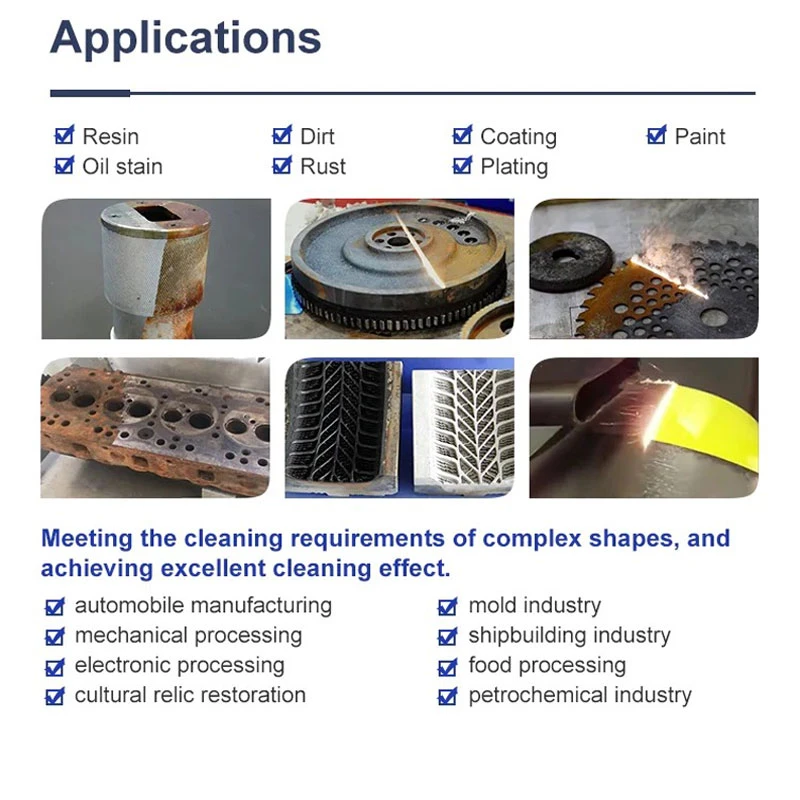
The wide range of applications of laser cleaning in various fields includes:
Mold cleaning: Lasers can achieve non-contact cleaning of molds, ensuring safety on the mold surface, maintaining its precision, and removing submicron-sized contaminants that traditional cleaning methods cannot remove, achieving truly pollution-free, efficient, and high-quality cleaning.
Precise degreasing cleaning in the precision instrument industry:
The precision machinery industry often needs to remove esters and mineral oils used for lubrication and corrosion resistance from parts, usually using chemical methods, which often leave residues. Laser degreasing can completely remove esters and mineral oils without damaging the surface of the parts. Laser cleaning causes the explosive vaporization of a thin layer of oxides on the surface of parts, creating a shock wave that removes contaminants, rather than through mechanical interaction.
Rail Cleaning: Currently, pre-welding cleaning of rails relies entirely on abrasive grinding with grinding wheels and belts, resulting in severe damage to the substrate, significant residual stress, and high annual consumption of grinding wheel consumables, leading to high costs and severe dust pollution. Laser cleaning can provide a high-quality, efficient, and green cleaning technology for high-speed railway track laying in my country, solving these problems, eliminating welding defects such as holes and ash spots in seamless rails, and improving the stability and safety of high-speed railway operations.
Aerospace: Aircraft surfaces require repainting after a certain period, but the old paint must be completely removed before repainting. Chemical soaking/wiping is the main paint removal method in the aerospace industry, generating a large amount of chemical waste and failing to achieve localized paint removal. This process is labor-intensive and harmful to health. Laser cleaning can achieve high-quality removal of paint from aircraft skin surfaces and is easily automated. Currently, this technology has begun to be applied to the maintenance of some high-end aircraft models abroad.
Marine Industry: Currently, pre-production cleaning of ships mainly uses sandblasting, which causes severe dust pollution and has been gradually banned, leading to reduced or even halted production at shipbuilding companies. Laser cleaning technology will provide a green and pollution-free cleaning solution for anti-corrosion coating of ship surfaces.
In the military industry, laser cleaning technology is widely used in weapon maintenance. Laser cleaning systems can efficiently and quickly remove rust and contaminants, and can be selectively applied to specific areas, achieving automated cleaning. Laser cleaning not only achieves a higher level of cleanliness than chemical cleaning processes but also causes virtually no damage to the surface of objects.