
What is UV Laser Marking Machine?
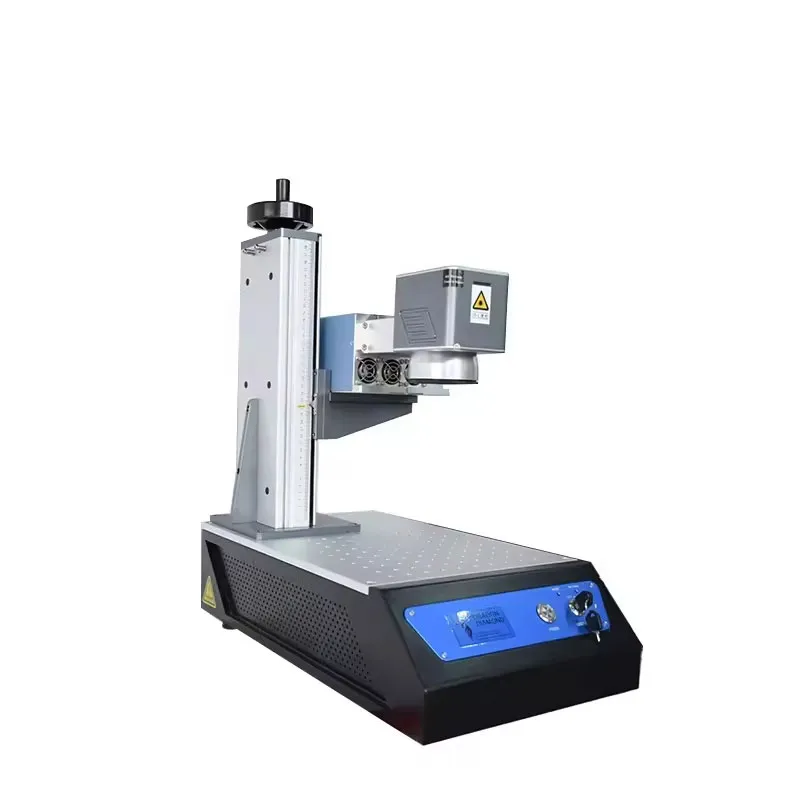
UV laser marking machine is a precision processing device that uses a high-energy ultraviolet laser beam to make permanent marks on the surface of materials. Its core principle is to achieve non-contact marking with micron-level precision by using the “cold processing” characteristics of ultraviolet laser (wavelength is usually 355nm).
Table of Contents
Core Principle of Laser Marking Machine
Laser Characteristics
Ultraviolet lasers are short-wavelength lasers (355nm) with high photon energy, capable of directly breaking the molecular chains or chemical bonds of materials, rather than through thermal melting or vaporization. This “cold processing” method significantly reduces the heat-affected zone (HAZ), preventing material deformation or scorching.
Marking Mechanisms
Physical Etching: Removing the surface layer of a material using laser energy to form grooves or textures.
Chemical Modification: Altering the molecular structure of the material surface to produce color contrast (e.g., the blackening of plastics through oxidation).
Photochemical Reaction: Initiating photochromic reactions in special materials (such as certain coatings).
Main Features and Advantages of UV Laser Marking Machine
Ultra-precision processing
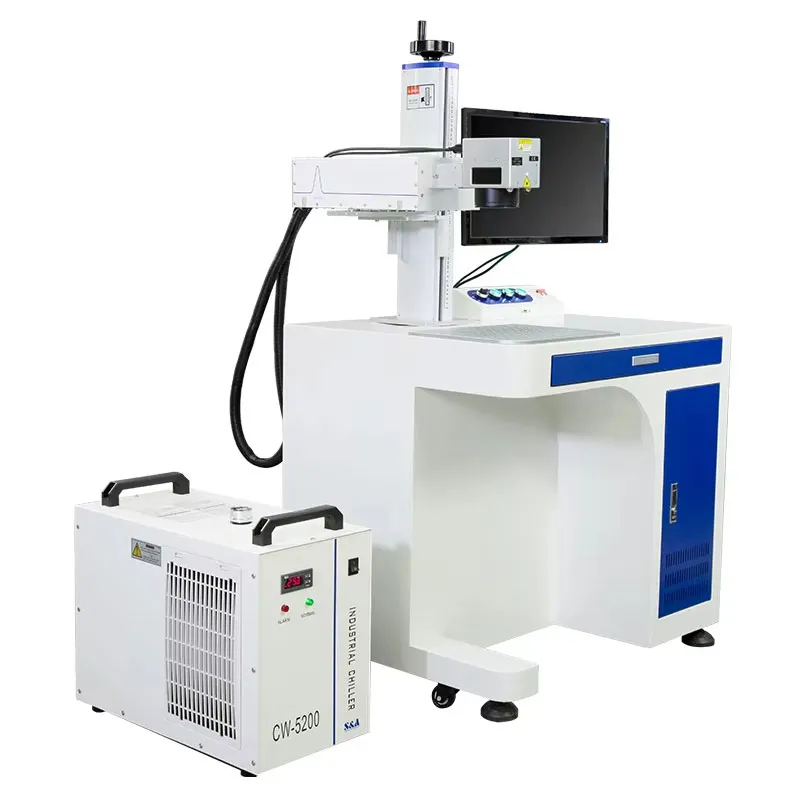
Ultraviolet lasers have extremely short wavelengths, allowing for very small focused spots (e.g., less than 20 micrometers) and extremely small heat-affected zones (less than 0.1 millimeters), thus enabling extremely fine marking and engraving effects.
Wide range of applicable materials
Except for some metals (such as copper), it can be widely applied to various metallic and non-metallic materials, and is particularly adept at processing heat-sensitive materials.
High marking quality
The produced marks have high contrast, are clear, strong, and durable, providing strong anti-counterfeiting capabilities.
Environmentally friendly and pollution-free
As a non-contact processing method, it requires no consumables such as ink, making it an environmentally friendly marking solution.
Multiple functions
In addition to conventional planar marking, some models also have the capability for 3D curved surface marking and large-format marking.
Application of UV Laser Marking Machine
Electronics Industry
Marking precision components such as PCB boards, chips, and connectors.
Engraving brand logos or serial numbers on glass and ceramic casings.
Medical Industry
Marking model numbers and batch numbers on medical devices (such as scalpels and catheters) to meet FDA and other regulatory requirements.
Marking biocompatible materials (such as titanium alloy implants).
Packaging Industry
Printing anti-counterfeiting codes and production dates on pharmaceutical and food packaging to ensure clear and tamper-proof information.
Marking patterns or text on plastic and glass bottles.
Automotive Industry
Marking high-precision parts such as engine components and sensors.
Engraving decorative patterns on glass and plastic interior trim.
Jewelry Industry
Engraving personalized patterns or text on gold and silver jewelry and diamonds.
Comparison With Traditional Laser Marking Machines
Comparison With Traditional Laser Marking Machines
| feature | UV laser marking machine | CO₂ laser marking machine | Fiber laser marking machine |
|---|---|---|---|
| wavelength | 355nm (ultraviolet) | 10.6μm (infrared) | 1.06μm (near-infrared) |
| Processing method | Cold working (no heat-affected zone) | Heat treatment (materials prone to burning) | Hot working (applicable to metals) |
| Applicable materials | Plastics, glass, ceramics, films, etc. | Wood, leather, acrylic, etc. | Metal, some plastic |
| accuracy | Micrometer scale (10-20μm) | Millimeter scale (100-200μm) | Micrometer scale (20-50μm) |
| cost | Higher (high cost of lasers) | lower | medium |
Selection Recommendations
Material Compatibility
For processing heat-sensitive materials such as plastics, glass, and ceramics, UV laser marking machines are the preferred choice.
For processing metals or thick materials, fiber laser marking machines can be considered.
Precision Requirements
For marking tiny text or complex patterns, UV lasers are the only option.
Budget Constraints
UV laser equipment has a higher initial cost, but lower long-term maintenance costs, making it suitable for processing high-value-added products.
Conclusion
UV laser marking machines are an ideal choice for achieving high-precision, high-quality marking, especially in the field of material processing that is sensitive to thermal effects, where they have irreplaceable advantages.