
Platform Laser Welding Machine – Comprehensive Guide
In high-end manufacturing sectors such as precision hardware, electronic components, precision molds, and sensors, the industry’s requirements for welding precision, weld consistency, and mass production stability are continuously increasing. Traditional handheld welding suffers from large human errors and inconsistent finished products, making it unable to meet the demands of standardized mass production. Platform laser welding machines, as automated precision welding equipment, have emerged to address this need.
Table of Contents
What is platform laser welding machine?
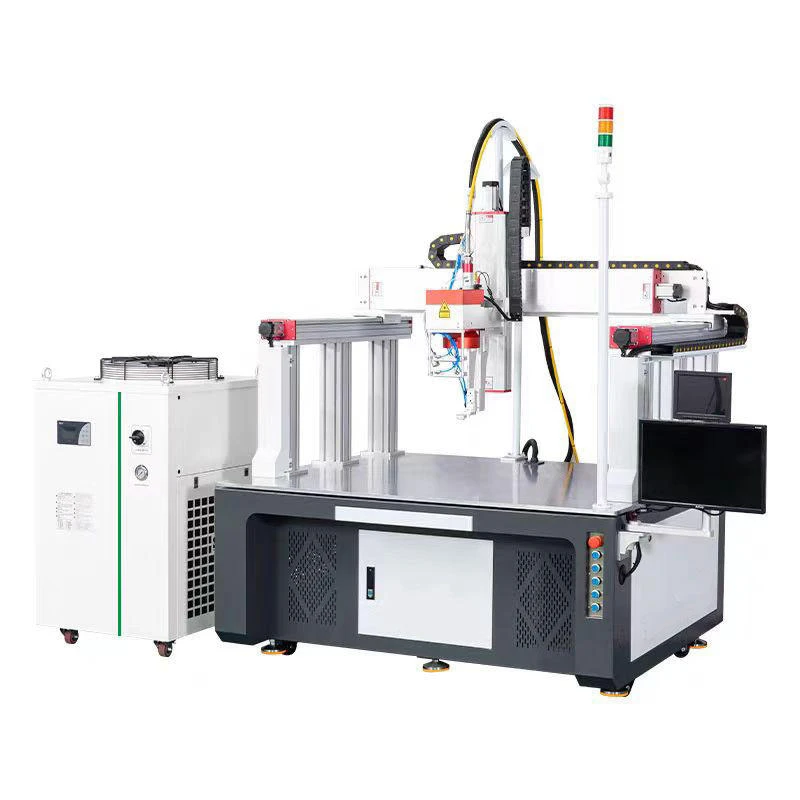
Platform laser welding machines are industrial welding equipment that use fiber lasers or pulsed lasers as welding heat sources, equipped with a precision CNC moving platform, to achieve automated and precise welding.
Working Principle of Platform Laser Welding Machine
The equipment’s laser outputs a stable, high-energy laser beam, which is focused by the optical path system to form a high-density energy spot. The instantaneous high temperature of the laser rapidly melts and fuses the metal at the welding point. The operator precisely places the workpiece on the CNC platform fixture, imports the welding trajectory and process parameters into the control system, and the equipment moves the worktable precisely, ensuring the workpiece passes uniformly through the laser welding point, completing continuous and uniform welding. The welding process features concentrated heat, rapid heating, and rapid cooling, with a minimal heat-affected zone, effectively ensuring that the workpiece’s shape remains unchanged and the weld is tight and strong.
Main Structure of Platform Laser Welding Machine
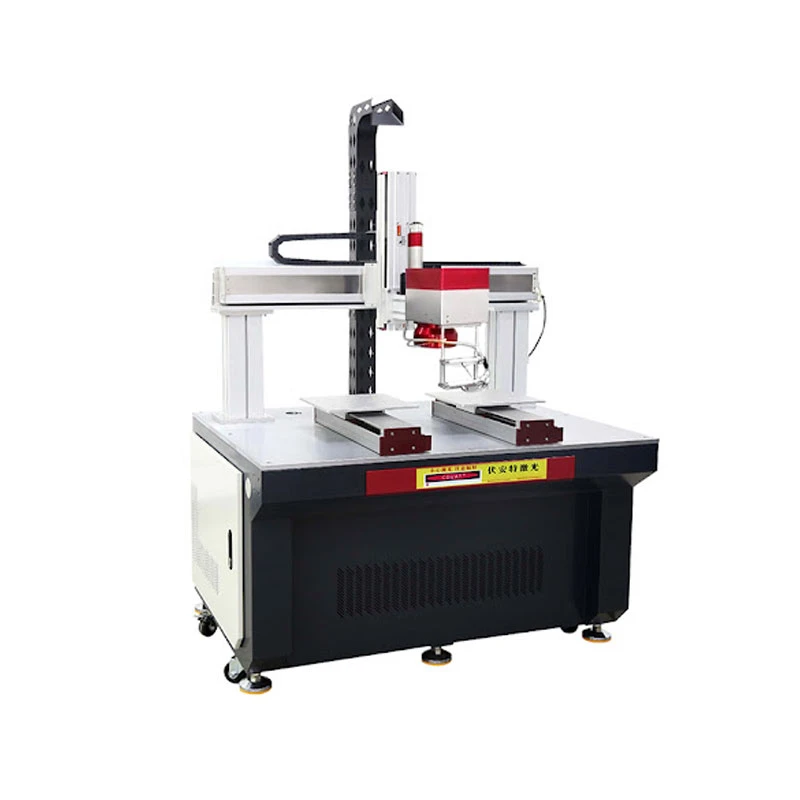
The entire machine mainly consists of a laser emitting host, a precision CNC motion platform, a dedicated welding fixture, a water-cooling system, an intelligent control system, and an optical focusing assembly. The equipment features a robust structure, minimal vibration during operation, precise positioning, and can be quickly switched between different workpiece specifications using various customized fixtures. It is easy to debug and maintains stable performance during long-term continuous operation.
Advantages of Platform Laser Welding Machine
Extremely High Welding Precision
The CNC platform offers precise positioning with minimal error, resulting in uniform weld point size and a smooth, fine weld seam, meeting stringent welding standards for precision components.
High Degree of Automation
One-button automatic welding reduces manual intervention and human error, easily enabling mass production on assembly lines.
Minimally Minimal Workpiece Deformation
Concentrated laser heating at a single point minimizes the heated area, reducing deformation and discoloration in thin-walled and precision parts, significantly improving finished product yield.
Stable and Consistent Welding Quality
All products maintain consistent welding strength, speed, and penetration depth, eliminating human error and ensuring high product standardization, suitable for mass production.
Simple and Easy-to-Use Operation
Process parameters are stored with a single click; parameters can be directly recalled when changing products. New operators can be trained quickly and operate the machine.
Long Service Life and Low Failure Rate
The machine boasts a mature and durable structure with no easily damaged or consumable parts. It operates quietly and smoothly, suitable for long-term, uninterrupted production in factories.
Application of Platform Laser Welding Machine
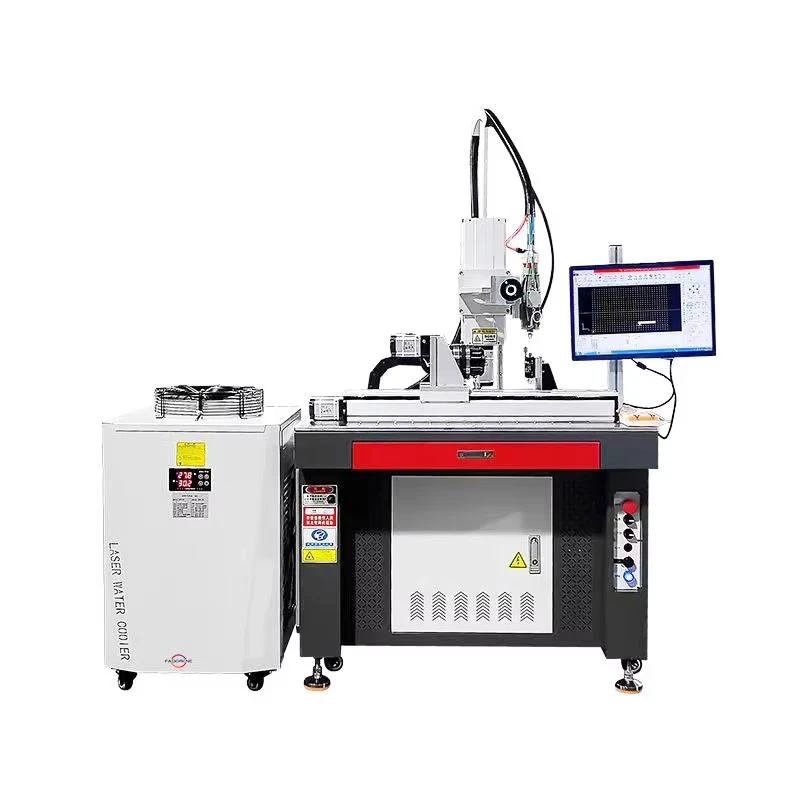
Platform laser welding machines are widely used in industries such as electronic battery accessories, sensors, precision hardware accessories, jewelry, medical device parts, instrument components, small mold repair, bathroom fixtures, automotive precision parts, and relay components. They are the preferred equipment for mass production welding of precision small parts.
Conclusion
In summary, the platform laser welding machine is a key piece of equipment for the modern precision manufacturing industry to achieve intelligent and standardized upgrades in welding processes. It perfectly solves industry problems such as poor precision, low efficiency, and inconsistent finished products in traditional manual welding.