
Laser Rust Removal Machine – Comprehensive Guide
Table of Contents
In industrial production and equipment maintenance, problems such as metal corrosion, oxide layers, old coatings, and oil stains have long plagued industries such as manufacturing, shipbuilding, and rail transportation. Laser rust removal machines play a significant role. Read this guide to learn more about laser rust removal machines.
What is a laser rust removal machine?
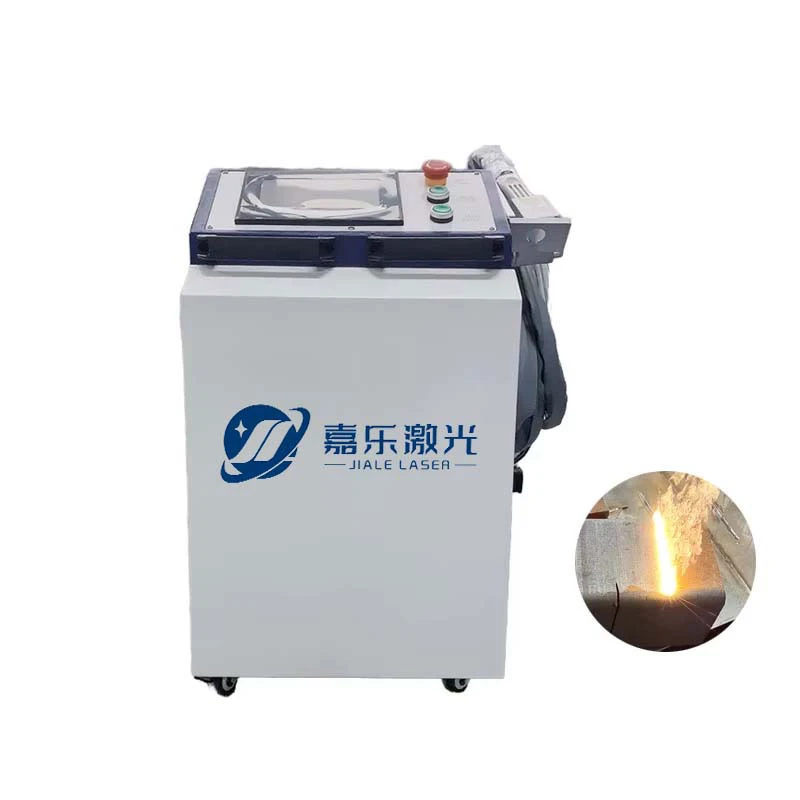
Laser rust removal machines utilize the photothermal and photovibration effects of high-energy pulsed laser beams to selectively remove rust, scale, old paint, oil, and impurities from metal surfaces without damaging the metal substrate. The core technology employs a 1064nm fiber pulsed laser (the mainstream choice), coupled with a high-speed galvanometer, a precision control system, and a negative pressure dust removal device. This enables non-contact, high-precision, and automated rust removal, making it a revolutionary alternative to traditional sandblasting and chemical cleaning.
Working Principle of Laser Rust Removal Machine
Laser Emission and Focusing: The laser outputs nanosecond-level pulsed laser light (wavelength 1064nm), which is focused into a micrometer-scale high-energy spot by a galvanometer, achieving a peak power density of 10⁶-10⁷ W/cm².
Selective Energy Absorption: Rust layers (such as iron oxide) have a high laser absorption rate of 70%-85%, while the metal substrate has a reflectivity exceeding 80%. Energy is absorbed only by the rust layer, leaving the substrate almost unaffected.
Instantaneous Vaporization and Detonation: After absorbing energy, the rust layer heats up to over 3000℃ within microseconds, instantly vaporizing or forming a plasma detonation, generating a 10-30 MPa shock wave that causes the rust layer to fragment and peel off.
Dust Collection and Substrate Protection: The peeled rust powder is collected by a negative pressure dust removal system, preventing dust diffusion throughout the process; the pulsed laser gap allows for rapid heat dissipation, preventing heat accumulation and damage to the substrate.
Key safety threshold: The ablation energy for rust layer is only 1.5-2.0 J/cm², while the energy required for damage to the metal substrate is >8.0 J/cm², thus naturally protecting the substrate.
Core Structural Components of Laser Rust Removal Machine
Pulsed Fiber Laser: The core component, with mainstream power ranging from 50W to 1000W, a wavelength of 1064nm, and a lifespan exceeding 100,000 hours, determining the efficiency and depth of rust removal.
High-Speed Galvanometer Scanning System: Controls the laser beam trajectory, achieving a focused spot size of 0.05mm and a scanning speed of 5-20 meters per minute, suitable for complex curved surfaces and precision areas.
Intelligent Control System: Supports parameter adjustment (power, pulse width, speed), path programming, and 3D vision positioning, and can be integrated with robotic arms for automated operation.
Cooling System: Dual-mode air/water cooling, providing real-time cooling for the laser and ensuring 24-hour continuous operation.
Negative Pressure Dust Removal Device: Simultaneously collects rust powder and impurities, eliminating dust pollution and meeting environmental standards.
Safety Protection Components: Enclosed protective cover, laser safety glasses, and safety interlock devices prevent laser leakage and radiation damage.
Advantages of Laser Rust Removal Machine
Ultimate Precision
Precise and controllable laser spot (0.05mm) allows for the removal of localized rust, grooves, threads, and other complex areas without damaging the substrate.
Zero Pollution
No sandblasting dust pollution, eliminating the need for large dust collection equipment, improving the workshop working environment, and reducing occupational disease risks.
Low Cost
Laser lifespan exceeds 100,000 hours, simple maintenance, low failure rate, and can operate continuously for 24 hours.
High Efficiency and Intelligence
Fast rust removal speed; a 100W machine can process 5-10㎡ per hour. Larger areas can be automated with robotic arms.
Superior Surface Quality
High surface cleanliness after rust removal (reaching ISO 8501-1 Sa3 level), with no residual impurities, improving adhesion for subsequent painting, welding, and electroplating.
Applications of Laser Rust Removal Machines
Industrial Manufacturing and Maintenance
Shipbuilding/Repair: Rust removal, scale removal, and old paint stripping for hulls, decks, and cabins.
Automotive/Rail Transportation: Rust removal and old paint removal for car bodies, frames, hubs, rails, and carriages.
Machinery Manufacturing: Precision rust removal for molds, machine tools, hardware parts, gears, and bearings.
Petrochemical/Nuclear Power: Rust removal and pre-corrosion treatment for pipelines, tanks, flanges, valves, and heat exchangers.
Precision and Specialty Fields
Cultural Relics Restoration: Rust removal for bronze, iron, and stone artifacts, with non-destructive protection of the artifacts.
Electronics/Precision Instruments: Removal of oxide layers and oil stains from circuit boards, precision components, and gold/silver plated parts.
Construction/Bridges: Rust removal and renovation of steel structure bridges, towers, and curtain walls.
Military/Aerospace: Rust removal and surface cleaning for precision parts, aircraft components, and weaponry.
Compared with Traditional Rust Removal Methods
| Comparison Dimensions | Laser rust removal machine | Sandblasting / shot blasting | Chemical pickling |
|---|---|---|---|
| Processing method | Non-contact | Mechanical friction | Chemical corrosion |
| Substrate damage | No damage | Easily worn and deformed | Easily corroded and prone to hydrogen embrittlement |
| Environmental protection | Zero pollution, dust is recyclable | Dust pollution is serious | Wastewater and waste liquid are toxic and pollute the environment. |
| accuracy | Micrometer-level precision area | Millimeter-level precision, prone to over-polishing | No precision, uniform corrosion |
| Consumable costs | No consumables, only electricity cost. | High sand consumption and high cost | High acid consumption and high cost |
| Surface quality | High cleanliness, no residue | There are sand particles remaining, and the surface is rough. | Chemical residues may remain, making it prone to rusting. |
| automation | Supports handheld/robotic arm automation | Difficult to automate | Manual operation is inefficient. |
Conclusion
With the continuous upgrading of laser technology and intelligent control, laser rust removal machines will develop towards higher power, smaller size, full automation, and AI intelligent recognition, continuously driving technological innovation in the metal surface treatment industry and providing core support for the high-quality development of modern industry.