
Laser Cleaning Process for Mold Coating and Nitride Layer Protection
Table of Contents
In industries such as injection molding, die casting, and rubber molding, to improve surface hardness, wear resistance, and mold release efficiency, most precision molds undergo surface strengthening treatments such as hard chrome plating, titanium nitride (TiN) coating, and ion nitriding. These plating and nitriding layers are thin, high in hardness, but brittle and sensitive. Traditional methods such as sandblasting, chemical cleaning, and dry ice cleaning easily cause coating peeling, nitriding layer cracking, and excessive surface roughness, which not only shortens the mold’s lifespan but also directly affects product yield.
Laser cleaning, with its non-contact, controllable energy, and precise targeting characteristics, has become the preferred solution for maintaining coated and nitrided molds. The core of protective laser cleaning is to thoroughly remove carbon deposits, oil stains, mold release agent residue, and oxide scale while ensuring the integrity of the plating and nitriding layers throughout the process, balancing cleaning efficiency and mold precision, through laser machine selection, precise parameter adjustment, and standardized operating procedures.
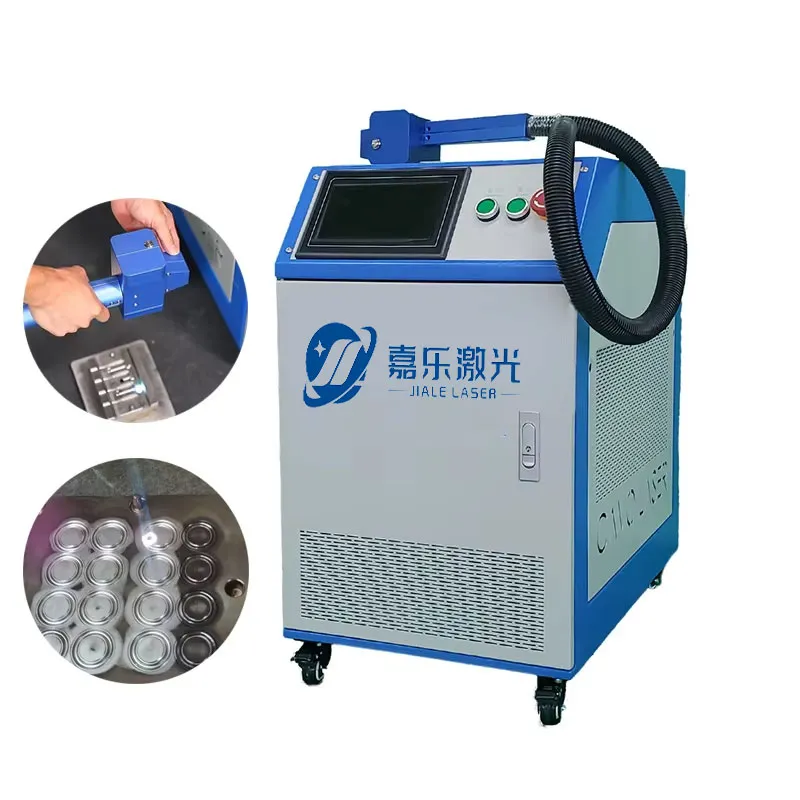
Characteristics and Cleaning Challenges of Mold Coatings and Nitriding Layers
Common surface strengthening layers for molds fall into two main categories. These two types differ in physical properties, resulting in significantly different cleaning risks, which forms the basis for differentiated process design.
Metal/Ceramic Coatings
Primarily hard chrome plating, TiN coatings, and DLC (diamond-like carbon) coatings. Coating thickness typically ranges from a few micrometers to tens of micrometers. The surface is dense and smooth, resistant to high temperatures but with weak thermal shock resistance. Excessive laser energy or heat input can easily lead to coating discoloration, blistering, peeling, and microcracks, compromising the original protective performance of the mold.
Nitriding Layers
Hardened layers formed using ion nitriding or gas nitriding processes. The depth is generally 0.1~0.5mm. They offer high hardness and excellent wear resistance, but are brittle. Instantaneous high temperatures and repeated thermal expansion and contraction can cause cracking and localized peeling of the nitriding layer, leading to mold damage and product scratches.
The common challenge of both types of reinforcement layers is that contaminants (carbon deposits, sulfides, stubborn oil stains) are tightly bonded to the surface. Thorough removal of the contaminants is crucial while strictly controlling the heat-affected zone (HAZ), placing extremely high demands on the laser’s energy density, pulse mode, and scanning method.
The Core Principle of Protective Laser Cleaning
Protective laser cleaning differs from conventional rust removal and thick paint stripping processes by following a selective cleaning logic of “contaminants preferentially absorb energy, while the surface reinforcement layer absorbs heat less”. The equipment emits a laser beam of a specific wavelength and pulse format. Contaminants (organic carbon deposits, oxides) have a much higher laser absorption rate than coatings and nitride layers. After the laser energy is rapidly absorbed by the contaminants, they instantly vaporize and thermally expand, detaching from the mold surface with a slight impact force.
Simultaneously, a cold-processing cleaning logic is employed. Short-pulse lasers compress the thermal action time, locking the heat within the contaminant layer. This significantly reduces heat conduction to the coating, nitride layer, and mold substrate, controlling the HAZ at the micron level and preventing coating damage and nitride layer cracking at the source. The entire process is non-contact, with no mechanical friction, and will not scratch precision cavities and textures.
Equipment Selection: Standard Models Compatible with Coating/Nitriding Layer Molds
Model selection is fundamental to process implementation. Different laser types, powers, and pulse modes determine the upper limit of the protective effect. There are clear selection principles for coating and nitriding layer molds.
Laser Source and Wavelength
The mainstream choice is a 1064nm nanosecond pulsed fiber laser. This wavelength has low absorption for metal coatings and nitriding layers, but high absorption for carbon deposits and oxide scale, naturally possessing selective cleaning advantages. For ultra-high precision mirror-coated molds, ultraviolet lasers can be used, resulting in less heat-affected zones and suitability for micron-level precision control scenarios. Continuous wave lasers are strictly prohibited, as their high heat input can easily cause thermal damage to the reinforcement layer.
Power Range Selection
1000W~2000W pulsed laser cleaning machines are preferred, representing the industry’s standard golden power range. Low-power models lack sufficient energy and cannot thoroughly clean stubborn dirt; high-power models of 3000W and above have high energy density and require strict parameter reduction for use, suitable only for thick layers of oxidized stains.
Core Configuration Requirements
Equipped with a high-precision galvanometer system, supporting path programming and stepless adjustment of spot size, adaptable to deep grooves, fine lines, and corner positions in molds;
Standard industrial water cooling system ensures stable energy output during long-term continuous operation, preventing localized overheating caused by power fluctuations;
Optional air-blowing dust removal component promptly removes vaporized fumes and residues to prevent secondary adhesion, while also assisting in surface cooling.
FAQ
Slight discoloration of the coating after cleaning
Causes: Excessive localized heat accumulation, slow scanning speed. Solution: Reduce laser power, increase scanning speed, increase the number of scans, and use multiple thin scans.
Micro-cracks appear at the edges of the nitride layer
Causes: Excessive single-pulse energy, fixed-point smudging. Solution: Switch to short-pulse mode, reduce the spot size, strictly prohibit fixed-point scanning, and reduce energy by 30% at corners.
Incomplete cleaning of stubborn carbon deposits, and reluctance to increase power
Solution: Use an auxiliary air blowing device, slightly increase the pulse frequency, and clean in 3-5 layers to gradually remove stubborn dirt.
Fine scratches appear on the mirror coating
Causes: Uneven spot energy, secondary friction from residue. Solution: Replace with a flat-top laser spot, activate the air blowing function, and promptly remove residue.
Conclusion
The coating and nitriding layer of a mold are the core barriers to ensure mold precision and extend its service life. Traditional cleaning processes can no longer meet the needs of non-destructive maintenance. The coating and nitriding layer protective laser cleaning process, relying on the cold processing characteristics of pulsed lasers, precise parameter control, and standardized operation procedures, achieves efficient decontamination while comprehensively protecting the surface reinforcement layer of the mold.