
Laser Cleaning Machine User Guide
n the fields of industrial manufacturing and precision machining, laser cleaning technology, with its non-contact, pollution-free, and high-precision characteristics, is gradually replacing traditional chemical cleaning and mechanical polishing methods. This article will systematically explain the usage of laser cleaning machines from four dimensions: working principle, operation procedure, safety regulations, and industry applications.
Table of Contents
Laser Cleaning Technology Principle
The core of laser cleaning lies in the interaction between a high-frequency, short-pulse laser beam and the material surface. When a high-energy beam of a specific wavelength irradiates a rust layer, paint layer, or contaminants, the energy is absorbed and converted into heat, forming a rapidly expanding plasma (highly ionized gas) and generating shock waves. This process achieves cleaning through three mechanisms:
Phosporization/Photodecomposition: High temperatures cause contaminants to instantly vaporize or decompose into tiny particles;
Photoexfoliation: Thermal expansion forces overcome the adhesion between contaminants and the substrate, causing them to detach;
Photovibration: High-frequency pulsed lasers excite ultrasonic resonance, pulverizing stubborn dirt.
Taking the removal of old paint from aircraft as an example, traditional mechanical grinding easily damages the metal substrate, while laser cleaning can complete the complete paint removal of an A320 passenger plane within two days, reducing the surface roughness of the metal by 30% and significantly improving the adhesion of subsequent paint spraying.
Laser Cleaning Machine Operation Procedure
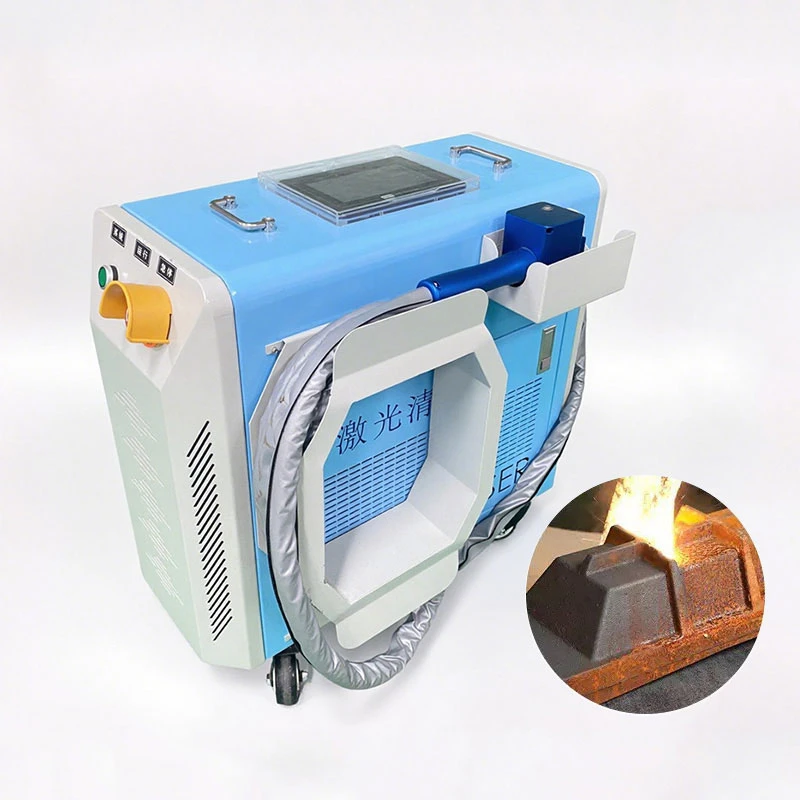
Equipment Pre-inspection and Safety Preparation
Environmental Inspection: Ensure good ventilation in the work area, temperature controlled between 5-40℃, humidity ≤80%, and avoid condensation on the laser.
Safety Protection: Wear laser safety goggles (OD value ≥4+), dust masks, and heat-resistant gloves. Set up warning signs in the operating area.
Equipment Connection: Check that the power cord (220V/50Hz), fiber optic transmission line, and cooling water pipes are securely connected to avoid the risk of leakage or laser interruption.
Parameter Setting and Calibration
Power Adjustment: Select the laser power according to the material characteristics (e.g., 80-120W for aluminum alloy paint removal, 150-200W for carbon steel rust removal).
Pulse Frequency: Control the heat-affected zone; 20-50kHz is recommended for thin plate cleaning, and 5-20kHz can be used for thick plate rust removal.
Scanning Speed: Adjust the spot movement speed (500-3000mm/s) using the galvanometer system to avoid localized overheating.
Focus Calibration: Use the red light preview function to adjust the distance between the cleaning head and the workpiece (usually 100-200mm) to ensure clear laser spot focus.
Cleaning Operation Implementation
Sample Testing: Perform small-area cleaning on the edge of the workpiece to verify the rationality of the parameters and observe whether the substrate is discolored or damaged.
Layered Cleaning: For multi-layer coatings (such as primer + topcoat + putty), adopt a “low power – high frequency” gradual peeling strategy. After cleaning each layer, blow away residue with compressed air.
Path Planning: Use an “S”-shaped or spiral scanning path, controlling the overlap rate at 30%-50% to ensure no missed areas.
Process Monitoring and Adjustment
Real-time Observation: Monitor the cleaning effect through a CCD camera or red light indicator. If substrate damage or incomplete cleaning occurs, adjust the parameters immediately.
Temperature Control: After continuous operation for more than 2 hours, check the cooling water temperature. If it exceeds 35℃, stop the operation to prevent the laser from shutting down due to thermal protection.
Shutdown and Maintenance
Procedure: First, turn off the laser emission button. After the equipment has cooled down for 10 minutes, turn off the main power switch. Finally, disconnect the cooling water circulation.
Lens Cleaning: Wipe the focusing lens and reflecting mirror with a lint-free cloth dampened with isopropyl alcohol, avoiding scratching the coating.
Waste Disposal: Collect the dust generated during cleaning (such as iron oxide and paint particles) and store it according to hazardous waste standards.
Safety Regulations
Laser Radiation Protection
Direct Irradiation: Never look directly at the laser spot with the naked eye. Even with protective eyewear, avoid prolonged direct viewing.
Reflection Risk: When cleaning highly reflective materials (such as stainless steel and copper), apply a light-absorbing coating to the workpiece surface to prevent secondary reflections that could cause injury.
Electrical Safety
Grounding Protection: Ensure the equipment casing is reliably grounded to prevent electric shock accidents caused by leakage.
Anti-static Measures: When operating in a dry environment, operators must wear anti-static wrist straps to prevent electrostatic discharge from damaging the laser module.
Mechanical Safety
Workpiece Fixation: Use dedicated clamps to secure the workpiece to prevent displacement or tipping due to vibration during cleaning.
Fiber Optic Protection: Avoid bending fiber optic cables with a radius less than 150mm to prevent the risk of arcing caused by internal fiber breakage.
Laser Cleaning Machines For Industrial Applications
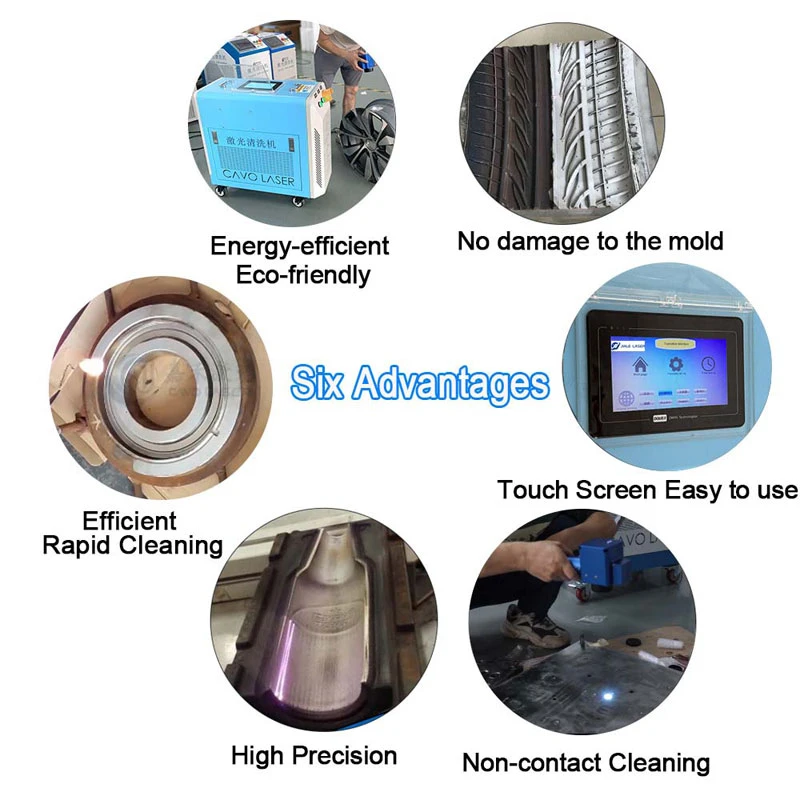
Aerospace Industry
Engine Blade Cleaning: Removes sulfide deposits from the thermal barrier coating (TBC) surface, restoring aerodynamic performance. Cleaning efficiency is 5 times higher than chemical pickling.
Satellite Component Decontamination: Uses laser cleaning in a vacuum environment to remove molecular contaminants from the surface of optical components, avoiding the introduction of fiber residues by traditional wiping.
Automotive Manufacturing Industry
Battery Electrode Cleaning: Uses nanosecond lasers to remove the oxide layer from the surface of copper foil, reducing contact resistance to below 0.5mΩ and improving battery charging and discharging efficiency.
Body-in-White Weld Cleaning: Removes oil stains from the surface of galvanized sheets before welding, improving weld penetration uniformity by 20% and reducing porosity defects.
Cultural Relics Conservation Industry
Bronze Rust Removal: Achieves “selective rust removal” by lowering the laser power (10-20W), retaining the green rust layer (basic copper carbonate) while removing harmful chlorides.
Stone Artifact Cleaning: Uses wet laser cleaning technology, pre-coating the stone surface with a water film to reduce thermal stress and avoid the propagation of microcracks caused by dry cleaning.
Nuclear Industry Sector
Reactor Pipeline Cleaning: A laser beam is transmitted through optical fiber into the radiation zone to remotely remove radioactive dust from the inner walls of the pipelines. A single operation can reduce the radiation dose to operators by 80%.
Conclusion
Laser cleaning technology is not only an innovation in cleaning methods, but also a key support for the green and intelligent transformation of the manufacturing industry. Mastering its scientific application methods will provide enterprises with a core competitive advantage in improving production efficiency and reducing environmental risks.