
How Can Mold Factories Efficiently Clean Molds?
In the process of mold manufacturing and use, mold cleaning is a crucial step in ensuring product quality, extending mold life, and maintaining production efficiency. Efficient mold cleaning not only removes dirt, residue, and rust from the mold surface but also prevents mold wear and corrosion, ensuring the mold remains in optimal condition during subsequent production. This article will explore various methods and strategies for mold factories to achieve efficient mold cleaning.
Table of Contents
Traditional Cleaning Methods
Manual Cleaning
Manual cleaning is the most basic mold cleaning method, suitable for small molds or cleaning delicate areas. Traditional manual cleaning often uses brushes, cloths, and cleaning agents, but it is inefficient and the cleaning quality is inconsistent. To improve efficiency, mold factories can take the following measures:
Select appropriate tools: Choose brushes of different hardness and materials according to the mold’s material, shape, and type of dirt. For example, a soft-bristled nylon brush can be used for the small crevices of precision molds; for stubborn dirt on the surface, a wire brush can be used, but care should be taken to avoid scratching the mold surface with excessive force. At the same time, use a special cloth with good absorbency to quickly dry the mold and reduce water residue.
Optimize cleaning agent selection: Select targeted cleaning agents for different dirt compositions. For example, alkaline cleaning agents can be used for oil stains; acidic rust removers can be used for rust. Furthermore, prioritize environmentally friendly cleaning agents, which can reduce environmental pollution and minimize the impact on the health of operators.
Establish standardized operating procedures: Clearly define the steps, sequence, and pressure requirements for manual cleaning to ensure that every operator follows a unified standard, improving the consistency of cleaning quality and efficiency. For example, clean the easily soiled areas of the mold first, then gradually expand to the entire mold surface; for complex molds, clean them in sections according to a specific order to avoid omissions.
Mechanical Cleaning
Mechanical cleaning utilizes the friction and impact forces generated by mechanical equipment to remove dirt from the mold surface. Common methods include sandblasting and polishing.
Sandblasting: Compressed air is used to propel abrasive particles onto the mold surface, using the impact and friction of the abrasive particles to remove dirt. To improve sandblasting efficiency, mold manufacturers can optimize sandblasting process parameters, such as adjusting sandblasting pressure, abrasive particle size, and spray angle. Generally, higher sandblasting pressure and appropriate abrasive particle size remove dirt faster, but excessive pressure may damage the mold surface; therefore, precise adjustments are needed based on the mold material and the degree of dirt accumulation. Simultaneously, regularly inspect and maintain the sandblasting equipment to ensure normal operation and avoid cleaning interruptions due to equipment failure.
Polishing and cleaning: High-speed friction is applied to the mold surface using a polishing wheel or belt to remove dirt and achieve a polishing effect. Choosing the appropriate polishing material and compound is crucial. For molds of different hardness, a polishing wheel of corresponding hardness should be selected to avoid excessive wear. Furthermore, controlling the polishing time and intensity is essential to prevent over-polishing from affecting the mold’s dimensional accuracy.
Application of New Cleaning Technologies
Ultrasonic Cleaning
Ultrasonic cleaning utilizes the cavitation effect generated by ultrasound in a liquid, causing tiny bubbles in the liquid to rapidly expand and burst, generating a powerful impact force to remove dirt from the mold surface. This cleaning method has advantages such as high cleaning efficiency, good cleaning quality, and minimal damage to the mold, making it particularly suitable for molds with complex shapes and tiny pores and crevices.
Appropriate Selection of Cleaning Solution: Choose a suitable ultrasonic cleaning solution based on the mold material and the type of dirt. The cleaning solution should have good solubility, dispersibility, and rust prevention properties, capable of quickly dissolving and removing various types of dirt while protecting the mold from corrosion. For example, for aluminum alloy molds, a neutral or weakly alkaline cleaning solution can be used; for stainless steel molds, an acidic cleaning solution can be used, but care must be taken to control the cleaning time and concentration to avoid corrosion.
Optimizing Cleaning Parameters: The effectiveness of ultrasonic cleaning is closely related to parameters such as cleaning frequency, power, temperature, and time. Generally, higher cleaning frequencies and power improve cleaning efficiency, but excessively high frequencies and power may damage the mold. Therefore, it is necessary to determine the optimal cleaning parameters through experiments based on the mold material and the degree of dirt accumulation. Meanwhile, appropriately increasing the cleaning temperature can accelerate the chemical reaction of the cleaning solution and enhance the cleaning effect. However, excessively high temperatures can also affect the stability of the cleaning solution and the performance of the mold. Generally, a cleaning temperature of 40-60℃ is suitable.
Laser Cleaning
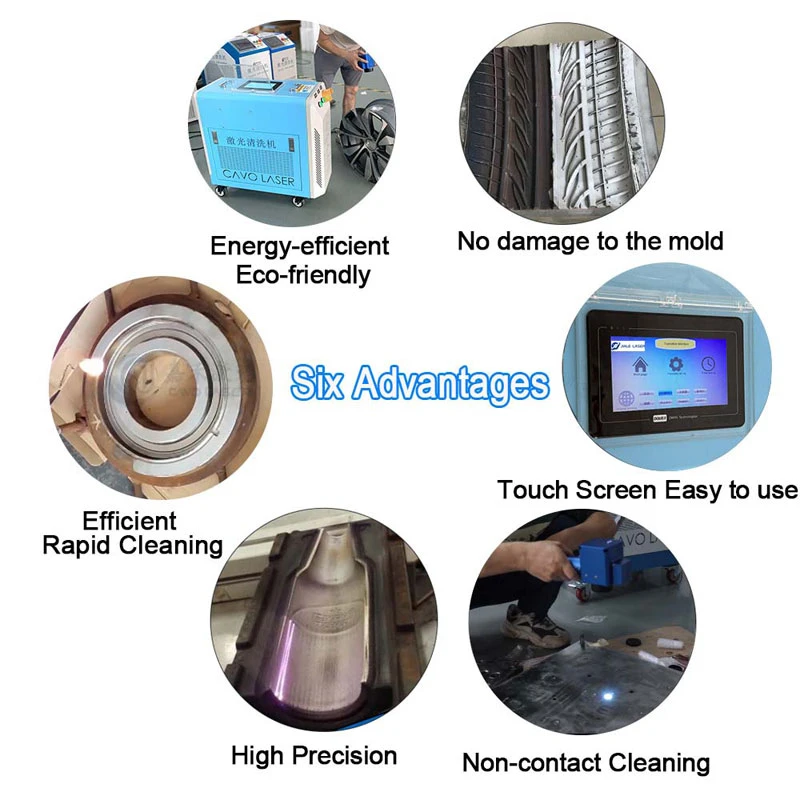
Laser cleaning is a new type of environmentally friendly cleaning technology. It uses a high-energy laser beam to irradiate the mold surface, causing the dirt to vaporize or peel off instantly, thus achieving the cleaning purpose. Laser cleaning has advantages such as non-contact, non-destructive, high cleaning precision, and the ability to automate cleaning. It is suitable for cleaning molds of various materials, especially for precision molds with extremely high cleaning quality requirements, where laser cleaning has unique advantages.
Equipment Selection and Parameter Setting: Select appropriate laser cleaning equipment based on the size, shape, and cleaning requirements of the mold. Different types of laser cleaning equipment differ in parameters such as power, wavelength, and pulse width, which need to be adjusted according to the actual situation. For example, for thinner molds or molds with high surface precision requirements, lower power and shorter pulse width laser parameters should be selected to avoid thermal damage to the mold.
Automated Cleaning System Integration: Integrate laser cleaning equipment with automated production lines to achieve automated mold cleaning. By programming and controlling the movement trajectory and cleaning parameters of the laser cleaning head, cleaning efficiency and consistency can be improved, reducing errors caused by manual operation. Furthermore, automated cleaning systems can be equipped with online monitoring devices to monitor cleaning results in real time, ensuring cleaning quality.
Mold Cleaning Process and Management
Pre-treatment before mold cleaning
Proper pre-treatment of the mold before formal cleaning can improve cleaning efficiency and effectiveness. Pre-treatment includes removing large debris, oil, and coolant from the mold surface. This can be done using compressed air blowing or manual wiping. For stubborn dirt, it can be softened by soaking in a special solvent, reducing the difficulty of subsequent cleaning.
Post-cleaning treatment and maintenance
After cleaning, the mold should be dried promptly to prevent moisture residue from causing rust. Methods include hot air drying, natural air drying, or using desiccants. After drying, the mold should be thoroughly inspected for any areas not completely cleaned or damage caused during cleaning. If necessary, a second cleaning or repair can be performed. Finally, the mold should be treated with rust-preventive oil or packaged with rust-proof materials to ensure it is not corroded during storage.
Personnel Training and Management
The skill level and sense of responsibility of the operators directly affect the quality and efficiency of mold cleaning. Mold factories should strengthen the training of cleaning personnel, ensuring they are familiar with various cleaning methods and equipment operating procedures, and master mold cleaning techniques and precautions. Simultaneously, a comprehensive performance evaluation system should be established to incentivize operators to improve work efficiency and cleaning quality, ensuring that mold cleaning work is carried out efficiently and systematically.
Conclusion
By rationally selecting cleaning methods and equipment, optimizing cleaning parameters, and establishing a comprehensive cleaning plan and personnel training system, mold factories can significantly improve the efficiency and quality of mold cleaning, reduce mold maintenance costs, and extend mold lifespan, thereby enhancing the overall competitiveness and production efficiency of the enterprise.
If you need to order a laser cleaning machine, start here. JIALELASER will provide you with products that exceed your expectations.