
For removing oxidation from workpieces, pulsed laser cleaning is the preferred choice; continuous-wave (CW) laser cleaning is not recommended.
In the process of removing oxide layers and scale from metal surfaces, laser cleaning has increasingly replaced traditional methods such as sandblasting, acid pickling, and mechanical grinding. Many procurement and process engineers struggle with the choice between pulsed lasers and continuous-wave (CW) lasers. The definitive conclusion is this: pulsed laser cleaning should be prioritized for removing oxidation, while CW laser cleaning is generally not recommended for such applications. The core difference between the two lies not in whether they can remove the oxide layer, but in their cleaning mechanisms, heat input, protection of the substrate, and compatibility with subsequent processes.
Pulsed lasers deliver short pulses with high peak energy. Through instantaneous nanosecond-scale energy impacts, plasma shockwaves, and micro-ablation, they strip or vaporize the oxide layer from the substrate surface. Because the duration of each pulse is extremely short and heat dissipates rapidly during the intervals between pulses, the thermal energy is concentrated almost exclusively on the oxide layer itself. It rarely penetrates deep into the metal substrate, making this a near-“cold” cleaning process with a minimal heat-affected zone (HAZ).
In contrast, CW lasers provide a stable, uninterrupted beam. They rely on continuous thermal ablation to heat, melt, and burn away the oxide layer. Since energy is applied continuously, heat accumulates and penetrates into the substrate—a significant drawback when the goal is oxide removal.
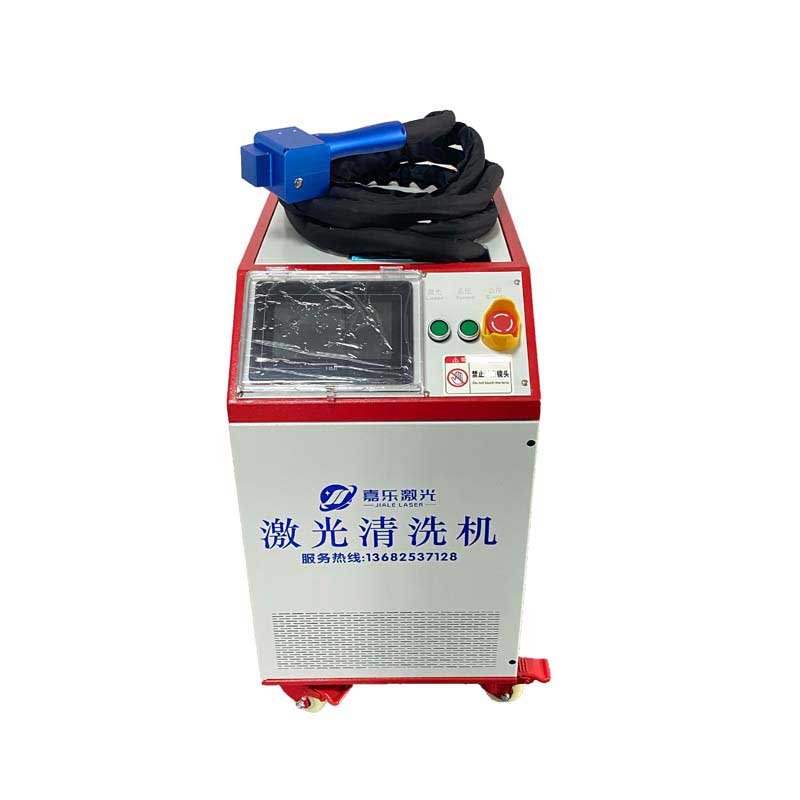
Using CW lasers to remove oxide layers typically presents four major process challenges:
First, secondary oxidation occurs very easily. In a high-temperature environment, the freshly exposed metal substrate re-oxidizes almost instantly, resulting in blackening, bluing, or tempering colors. The surface appears unclean, necessitating additional processing; it fails to meet the requirements for pre-treatment prior to welding or coating.
Second, the metallurgical structure and mechanical properties of the substrate can be compromised. Sustained high temperatures may cause metal annealing or a reduction in hardness, potentially rendering molds, precision structural components, or heat-treated parts unusable or non-compliant with performance specifications. Thin sheets, thin-walled components, and aluminum alloys are particularly susceptible to deformation, warping, and a loss of dimensional tolerance control.
Third, surface consistency is poor, and the process lacks precise controllability. The thickness of an oxide layer is rarely uniform. With continuous-wave (CW) lasers, the cumulative thermal effect is significant: thinner oxide areas are easily over-processed, leading to substrate erosion or pitting, while thicker oxide scales may not be removed completely—resulting in inconsistent yields.
Furthermore, CW laser cleaning can hinder subsequent processes. The heat-tinting and residual surface stress left behind can negatively affect weld quality and coating adhesion. Consequently, many sectors—including precision manufacturing, aerospace, automotive parts, and mold production—explicitly prohibit the use of CW lasers for oxide removal.
In contrast, pulsed laser cleaning effectively addresses these pain points:
✅ Low heat input ensures the substrate remains free from deformation or annealing, making it suitable for molds, precision components, thin sheets, aluminum alloys, and stainless steel.
✅ It inhibits secondary oxidation, revealing the original metal surface without noticeable tempering colors; this serves as a comprehensive, one-step preparation for welding, coating, or electroplating.
✅ Selective cleaning allows for the precise removal of only the oxide layer; once parameters are optimized, the process remains stable and consistent, resulting in low rework rates.
✅ As a non-contact cleaning method, it leaves no abrasive particles or chemical residues, ensuring an environmentally friendly, clean finish that meets the stringent requirements for high-end components.
✅ It is highly versatile, capable of removing oxides from a wide range of materials, including carbon steel, stainless steel, aluminum alloys, and copper.
This is not to say that CW lasers are entirely useless; they are suitable only for a very narrow range of specific scenarios—such as removing heavy rust, thick oxide scales, or scale from raw steel plates—where there are no requirements regarding substrate hardness, surface finish, or dimensional precision, and the sole objective is the rapid removal of surface impurities. If a workpiece requires specific precision, surface quality, weldability, coating adhesion, or heat treatment, CW laser cleaning is not an appropriate choice.
While some clients may initially opt for CW lasers due to lower procurement costs and seemingly faster cleaning speeds, the total cost of ownership—factoring in rework, scrap, additional processing, and quality-related liabilities—is often significantly higher. Although pulsed laser systems require a higher initial investment, they offer a stable process and reliable, high-quality results, making them particularly well-suited for batch processing, high-end components, and the restoration of molds. Summary of Selection Recommendations
For the removal of oxide layers from workpieces, choose pulse laser cleaning if any of the following conditions apply:
- The items are precision parts, thin-walled components, heat-treated workpieces, or molds.
- The parts require subsequent processing such as welding, coating, electroplating, or non-destructive testing (NDT).
- It is required that the surface does not turn blue or black after cleaning, and that the original hardness and dimensions of the substrate are preserved.
- The materials are oxidation-prone or heat-sensitive metals, such as stainless steel, aluminum alloys, or copper.
Continuous-wave (CW) lasers should only be considered for thick, heavily rusted blanks where potential damage to the substrate is acceptable. When evaluating oxide removal, the key question is not merely whether the oxide can be stripped away, but whether the substrate remains functional and suitable for the next stage of the manufacturing process. This is the fundamental reason why pulse laser cleaning has become the primary solution for removing oxide layers from workpieces.