
Handheld Laser Rust Removal Solution | A Flexible, On-Site Alternative to Sandblasting and Acid Pickling
Rust is a common challenge in the maintenance of steel structures, molds, construction machinery, pipelines, flanges, hardware components, and equipment frames. Traditional methods—such as grinding with angle grinders, sandblasting, or acid pickling—often damage the base material, fail to reach tight corners, generate excessive dust, produce significant hazardous waste, or face strict environmental regulatory hurdles. The handheld laser cleaning solution, featuring a portable laser gun and a non-contact “optical stripping” process, is ideal for rust removal in workshops, outdoor job sites, or directly on large-scale equipment. It balances effective rust removal with the protection of the substrate and adherence to eco-friendly production standards, making it the leading choice for upgrading industrial rust-removal processes today.
I. Rust Removal Principle
Handheld fiber laser cleaning machines utilize a 1064nm laser beam to selectively remove rust by exploiting the difference in laser absorption rates between the rust layer and the metal substrate. Rust and oxide layers rapidly absorb the laser energy, causing them to instantly vaporize, fragment, and detach from the surface. Meanwhile, the underlying metal—such as carbon steel or stainless steel—reflects most of the laser energy; when the process parameters are correctly set, the substrate remains undamaged by excessive heat.
Pulsed laser systems function as a “cold” process with low heat input, making them suitable for precision components, light rust, or localized rust spots. Continuous-wave (CW) systems offer higher energy, making them better suited for removing thick rust, heavy oxide scale, or rust from large steel structures. Both types utilize a handheld scanning gun, allowing for free movement without being restricted by the size of the workpiece or the need for complex fixtures.
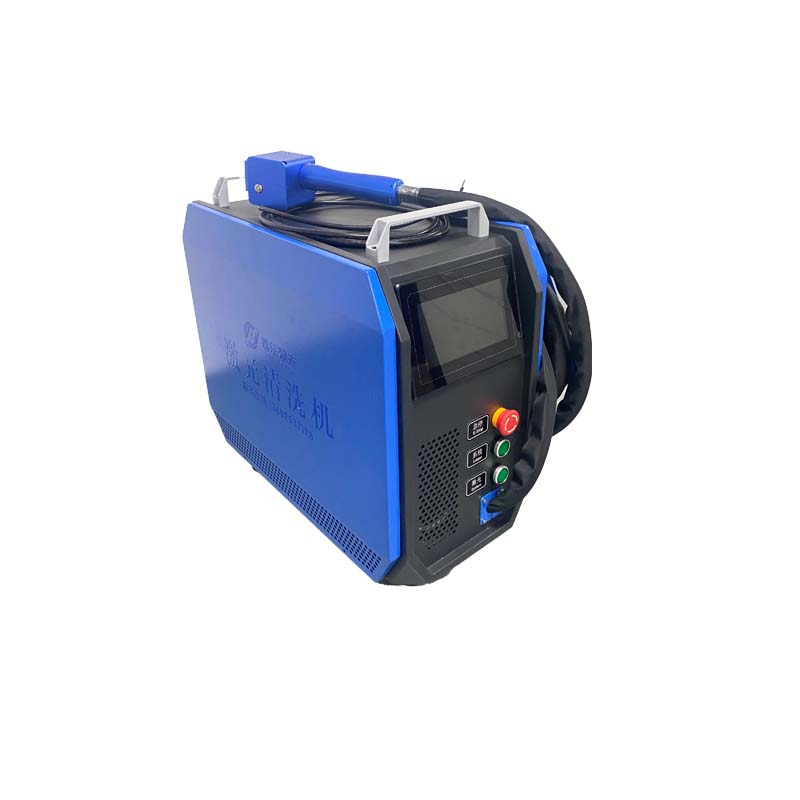
II. System Configuration
- Laser Main Unit: Available in pulsed versions (100W/200W for precision rust removal) and continuous-wave versions (300W/500W/1000W for thick rust and large areas). Most models are air-cooled and mounted on a cart for easy mobility, eliminating the need for a dedicated, fixed workspace. Water-cooled models are also available for long-duration, continuous operation. 2. Handheld Cleaning Gun: Features a flexible fiber-optic delivery system and a lightweight, maneuverable gun head. It supports oscillating scanning with an adjustable beam spot, making it suitable for complex areas such as flat or curved surfaces, weld seams, corners, threads, flange gaps, and the internal cavities of equipment.
- Control System: Equipped with a touchscreen interface and preset rust-removal recipes. Parameters such as power, frequency, scan width, and scan speed are adjustable and can be recalled with a single touch, allowing even beginners to get started quickly.
- Ancillary Systems: Includes a fume extraction and collection unit (for capturing metal oxide dust generated during the rust-removal process), specialized 1064nm laser safety goggles, protective shielding, a footswitch, and a power cord.
III. Key Advantages of the Solution
✅ Highly Mobile and Flexible for On-Site Rust Removal
Eliminates the need to dismantle large workpieces and transport them to a sandblasting facility. Rust removal can be performed directly on-site—whether on machine tool frames, construction machinery, pipelines, storage tanks, or steel structural supports—thereby reducing costs associated with disassembly, reassembly, and transport. Ideal for equipment maintenance, emergency repairs, and outdoor servicing.
✅ Non-Contact, Controllable Process That Preserves the Substrate
Unlike sandblasting, which can cause pitting or embed abrasive particles into the surface, this method involves no mechanical impact or chemical corrosion. The pulsed laser variant minimizes the heat-affected zone, ensuring that molds, precision castings, thin-walled components, and weld preparations do not suffer from deformation, annealing, or discoloration. The cleaned surface is left pristine and ready for subsequent processes such as welding, coating, or anti-corrosion treatment. Targeted cleaning of localized rust spots is possible without the need for extensive masking.
✅ No Consumables; Low Long-Term Operating Costs
The system consumes only electricity—no sand, chemical rust removers, sandpaper, or dry ice required. The laser source offers a long service life, and routine maintenance is simple (primarily involving periodic filter cleaning and ensuring the fiber-optic cable is not bent beyond its minimum bend radius). This eliminates ongoing expenses for purchasing consumables and disposing of hazardous waste.
✅ Environmentally Friendly and Dust-Free
Unlike acid pickling, which generates corrosive liquid waste, or open-air sandblasting, which creates significant dust pollution, this process is clean and environmentally compliant. Handheld laser rust removal requires no chemical agents. When paired with a fume extraction system, it keeps the workshop clean and free from pungent odors, meeting green manufacturing standards and helping facilities avoid the risk of regulatory interventions related to environmental compliance.
✅ Versatile and Multi-functional
Beyond removing rust and mill scale, the system can simultaneously clean off oil, thin layers of old paint, oxidation on weld seams, and carbon deposits. A single unit serves multiple purposes—including equipment maintenance, pre-weld surface preparation, and rust removal for refurbishment—thereby maximizing equipment utilization.
✅ Consistent Results for Reliable Quality Control
Once parameters are set, the system delivers stable, repeatable cleaning results. The level of rust removal is controllable—achieving approximately an Sa2.5 standard—which meets the surface preparation requirements for anti-corrosion coatings and eliminates the quality inconsistencies often associated with manual grinding.
IV. Typical Applications
- Equipment Maintenance: Targeted rust removal for construction machinery, machine tool frames, hydraulic valve blocks, gears, flanges, and motor housings.
- Steel Structures: Cleaning light-to-moderate rust from steel frameworks, pipelines, storage tanks, embedded components, and bridge elements.
- Mold Industry: Removing rust spots and oxidation layers from injection molding and die-casting molds (pulsed laser models are preferred).
- Welding Processes: Removing oxidation from weld bevels (pre-weld) and cleaning rust or mill scale from weld seams (post-weld).
- Hardware and Refurbishment: Removing rust from cast iron parts, carbon steel components, and aging equipment.
⚠️ Scope and Limitations: Pulsed handheld laser systems are best suited for thin or surface rust, localized corrosion, and precision workpieces. For very thick rust layers, heavy mill scale, or multi-layered, stubborn corrosion, high-power continuous-wave (CW) laser systems are recommended; otherwise, cleaning efficiency may be insufficient.
V. Standard Rust Removal Workflow
- Preparation: Remove surface oil and large, loose flakes of rust from the workpiece. Isolate the work area, remove any flammable materials, position the fume extraction intake close to the cleaning zone, and ensure operators wear appropriate laser safety goggles. 2. Sample Testing: Before starting, test the process on scrap material of the same type. Begin with low power settings and gradually increase parameters, using multiple light passes rather than a single high-energy pass to avoid damaging the substrate. Proceed with full-scale operation only after confirming effective rust removal and ensuring no discoloration of the substrate.
- Rust Removal Process: Move the handheld laser gun at a steady, uniform speed, ensuring the laser spots overlap consistently. Slow down when cleaning gaps, crevices, or edges. Continuously monitor the effectiveness of the fume extraction system.
- Post-Cleaning Inspection: Once rust removal is complete, verify the cleanliness of the surface. If anti-corrosion protection is required, apply an anti-rust primer promptly to prevent the recurrence of rust.
- Shutdown and Maintenance: Power down the unit, clean the filter screens, properly stow the fiber-optic cable, and ensure the equipment is protected from dust.
VI. Key Safety Guidelines
- The laser is classified as a Class 4 laser. Never look directly at the beam or its reflections. Operators must wear laser safety goggles rated for the specific wavelength in use, and all unauthorized personnel must remain outside the designated safety zone.
- Never point the laser at people or flammable materials. Exercise extra caution regarding reflected laser light when working on highly reflective workpieces.
- Always activate the fume purification system during rust removal; avoid inhaling metal dust.
- Do not sharply bend or step on the fiber-optic cable; strictly adhere to the manufacturer’s specified minimum bend radius. Do not touch the laser gun nozzle while the equipment is in operation.
- Ensure proper grounding when working in humid environments, and never operate the equipment with wet hands.
VII. Summary
Handheld laser cleaning and rust removal offer the core advantage of overcoming site limitations, effectively removing rust while preserving the integrity of the substrate. This solution addresses the common pain points of traditional rust removal methods, such as the difficulty of transporting large components, the risk of damaging precision parts, complex environmental compliance requirements, and high costs associated with consumables.
If your facility frequently requires on-site maintenance, mold care, pre-welding rust removal, or equipment refurbishment—especially when dealing with workpieces of varying sizes or scattered locations—this handheld laser rust removal system serves as an excellent, upgraded alternative to sandblasting, acid pickling, or manual grinding.