
Difference Between Laser Cleaning and Ultrasonic Cleaning
Laser cleaning machines work by using a laser to irradiate the surface of the material being processed, causing a change in the coefficient of thermal expansion that separates dirt from the surface. Simultaneously, the laser generates tens of millions of vibrations during the cleaning process, breaking down the separated dirt. Therefore, adjusting the parameters appropriately is crucial when using a laser cleaning machine to prevent damage to the material. Reasonable cleaning parameters can achieve damage-free cleaning. Ultrasonic cleaning works by utilizing the cavitation, acceleration, and direct flow effects of ultrasonic waves in a liquid. These effects directly and indirectly disperse, emulsify, and separate the dirt, achieving the cleaning purpose. Currently, traditional ultrasonic cleaning methods primarily utilize cavitation and direct flow effects.
Ultrasonic cleaning utilizes ultrasonic waves as a generator, emitting AC signals that are converted into AC mechanical oscillations by a transducer. These oscillations propagate to the cleaning medium (i.e., the rupture of “bubbles” in the cleaning fluid). When these cavitation bubbles reach the surface of the object being cleaned and rupture, they generate an impact force exceeding 1000 atmospheres, causing the dirt within the surface pores to disperse, break, and peel off.
Laser cleaning technology, on the other hand, concentrates energy within a very small spatial and temporal range, acting on the interface between the dirt and the substrate. This causes the dirt to vaporize, evaporate, or expand instantaneously due to thermal expansion, overcoming the surface’s adhesion to the particles and detaching them from the object’s surface.
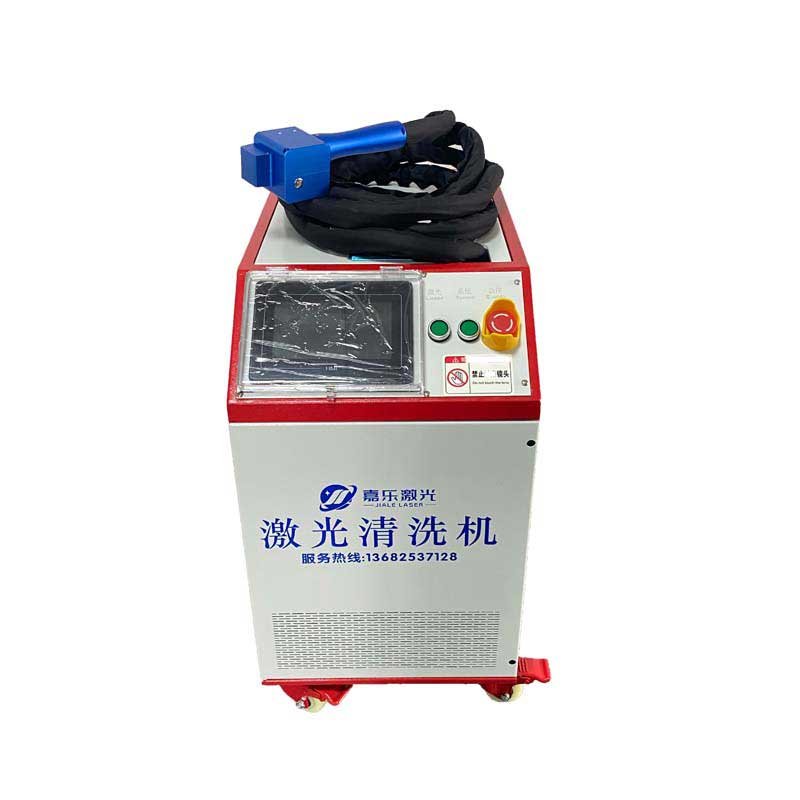
From their respective principles and characteristics, the difference lies in the ease of operation. Laser cleaning is generally handheld, requires no cleaning medium, and can directly clean object surfaces. It is highly effective for large-area cleaning and cleaning of precision parts, and can operate within a temperature range of -5°C to 50°C.
Ultrasonic cleaning requires the addition of a cleaning machine. Higher ultrasonic power density results in stronger cavitation and faster cleaning, leading to better cleaning results. However, for precision workpieces requiring high surface finish, prolonged high-power-density cleaning can cause cavitation corrosion. Ultrasonic cleaning is suitable for small volumes but cannot remove submicron particles or coatings, which are not issues with laser cleaning.
The difference between laser and ultrasonic cleaning machines lies in their significant advantages. Laser cleaning is highly efficient, fast, and low-cost, exerting minimal thermal and mechanical load on the processed materials, making the cleaning process non-destructive; it does not harm operator health; and the cleaning process is easily automated, enabling remote control cleaning.