
Will laser cleaning damage the mold cavity or surface coating?
Many factories have concerns before purchasing: Will high-temperature laser operation scratch the cavity, corrode the coating, or damage the nitrided hardening layer? In fact, standard processes and compatible machine models will not damage the mold substrate and protective layer. Only when the wrong machine model is selected, the parameters are adjusted incorrectly, or the operation is not standard will the surface be damaged.
Table of Contents
The Principle Behind Laser Cleaning That Doesn’t Damage Coatings or Cavities
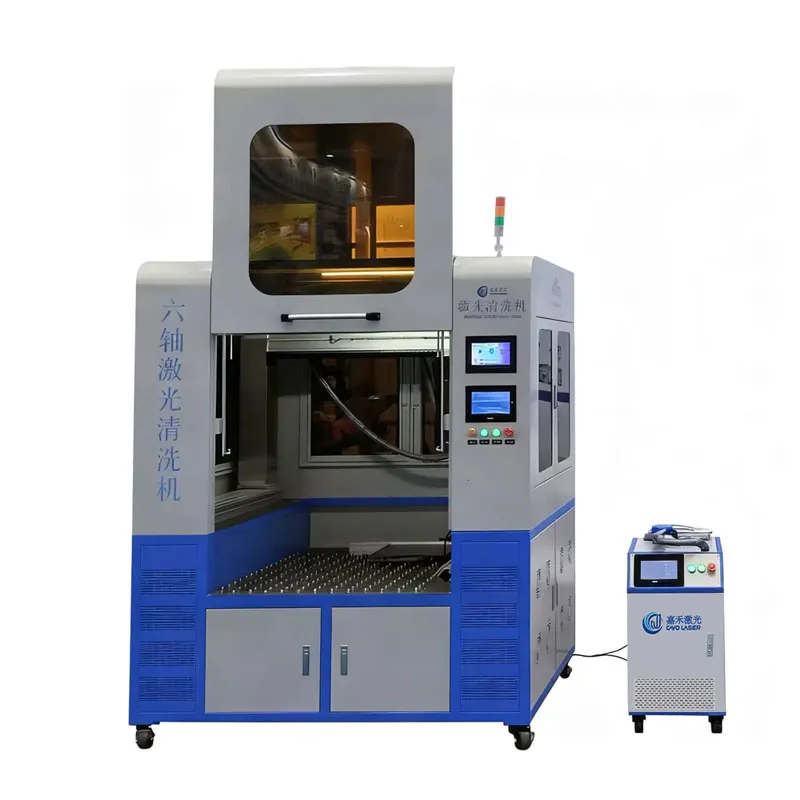
Pulsed fiber lasers achieve targeted decontamination through selective absorption: carbon deposits, mold release agent residue, and sulfide stains have an absorption rate of over 70% for 1064nm laser light, while the steel substrate, chromium plating, and nitride layers have a reflectivity of approximately 80% for the same wavelength. Most of the energy is absorbed by the contaminants, which instantly vaporize and peel off, with minimal heat absorption by the substrate and coating.
Combined with nanosecond short-pulse cold processing technology, the laser interacts with the workpiece for only a nanosecond, preventing heat from penetrating deep into the coating and cavity substrate, controlling the heat-affected zone to the micron level. Furthermore, simultaneous air blowing removes dust, instantly blowing away vaporized waste residue, preventing secondary burning of the mold by high-temperature residue. This physically achieves the goal of removing only contaminants while preserving the cavity and coating.
In contrast, continuous laser and high-power coarse cleaning methods result in large heat input and severe heat accumulation, which can easily lead to coating discoloration, bulging and peeling, and damage to the surface of the cavity due to tempering. This is also the origin of some mold damage cases on the market.
Four Major Causes of Damage to Mold Cavities and Plating
Incorrect Equipment Selection
Using continuous fiber laser cleaning equipment is the primary cause of plating damage. Continuous laser heat generation and large-area heat buildup easily cause cracking of the nitride layer and peeling of the chrome plating. For precision molds with plating, nanosecond pulse models must be used; 1000W–2000W pulse models are the preferred choice for general mold maintenance.
Inappropriate Process Parameters
Excessively high power settings, excessively slow scanning speeds, and excessive spot overlap rates cause prolonged laser irradiation at a single point, leading to localized heat overload, whitening and discoloration of the plating, and changes in the surface hardness of the cavity. Conversely, excessively low parameters result in incomplete cleaning and residue.
Improper Manual Operation
Operators lingering at the same spot for extended periods, repeatedly sweeping deep lines and venting groove edges, causes continuous heat buildup, damaging the weakest areas of the plating first. Failure to test on a mold edge before large-area cleaning is also a contributing factor.
Auxiliary components are missing
The air blowing system was not turned on, and the high-temperature dust after vaporization adhered to the coating surface and continued to burn, forming dotted ablation marks; excessive dust in the workshop and dirt on the lenses caused light spot distortion, uneven energy distribution, and localized energy surges that scratched the cavity.
Standardized practical operation of protective cavity and coating
Preliminary Sample Testing
Before formal full mold cleaning, a small area on the non-working surface of the mold corners is selected for trial cleaning. The coating is observed for discoloration and any marks on the cavity. Power and scanning speed are fine-tuned based on the actual stain condition. Full-area cleaning is then carried out only after the parameters meet the standards.
Graded Process Parameter Setting
For light oil stains and thin carbon deposits: use medium to low power, high scanning speed, and multiple thin-layer cleanings. For stubborn, hardened carbon deposits: slightly increase power, break down the number of scans, and replace a single high-power bombardment with multiple light sweeps. The overall parameters for chrome-plated and TiN-coated molds are lower than those for nitriding molds, requiring further strict control of heat input.
Standardized Gun Movement Technique
Follow the principle of uniform speed movement, and avoid fixed-point stops; move the gun horizontally evenly across the cavity plane, and side-sweep at a 15°–30° angle for both deep and shallow textures, avoiding direct vertical contact with sharp corners of the grooves to reduce heat exposure at the coating edges.
Supporting equipment is put into operation simultaneously
The adjustable air pressure blowing device is turned on throughout the process, with the air pressure controlled at 0.2–0.35MPa to promptly remove high-temperature waste residue; the protective lens is checked before each day’s operation, and any dirty lenses are replaced immediately to ensure uniform and stable light spot energy.
Conclusion
If you worry about laser cleaning damaging your mold cavity or coating, we support free sample cleaning test on your spare mold to verify the cleaning effect. Feel free to contact our technical team for personalized parameter solutions.