
What is Laser Cleaning?
Laser cleaning is an advanced surface treatment technology that utilizes the interaction between a high-energy laser beam and contaminants on a material surface to remove contaminants through physical or chemical processes. With its core advantages of being non-contact, pollution-free, high-precision, and highly controllable, it is widely used in industrial manufacturing, cultural relic preservation, and medical and health fields, and is hailed as a representative of “green cleaning technology.”
Table of Contents
Laser cleaning principle
Photothermal Effect (Ablation and Removal)
Laser energy is absorbed by contaminants (such as oil, oxide layers, and coatings), rapidly heating them to above their boiling or melting points, causing them to vaporize or liquefy. The surface is then peeled off through vapor pressure or liquid flow.
For example, in removing oxide layers from metal surfaces, the oxide layer vaporizes instantly after laser irradiation, while the substrate, due to its high reflectivity, remains almost unaffected.
Photomechanical Effect (Shockwave Removal)
High-energy pulsed lasers generate plasma on the surface of contaminants. As the plasma expands, it forms micro-shock waves that “loosen” and peel off the deposits.
For example, residual slag at weld joints can be quickly removed using laser shockwaves, avoiding damage to the substrate from mechanical grinding.
Photochemical Effect (Molecular Bond Breaking)
Ultra-short pulsed lasers (such as picosecond and femtosecond lasers) have extremely high energy densities, directly breaking the chemical bonds of contaminants, causing them to decompose into small molecules or atomic-level particles, which are then removed from the surface by airflow.
For example, cleaning nanoscale particles from semiconductor wafer surfaces, which are difficult to remove using traditional methods, can be achieved non-destructively with lasers.
The core advantages of laser cleaning
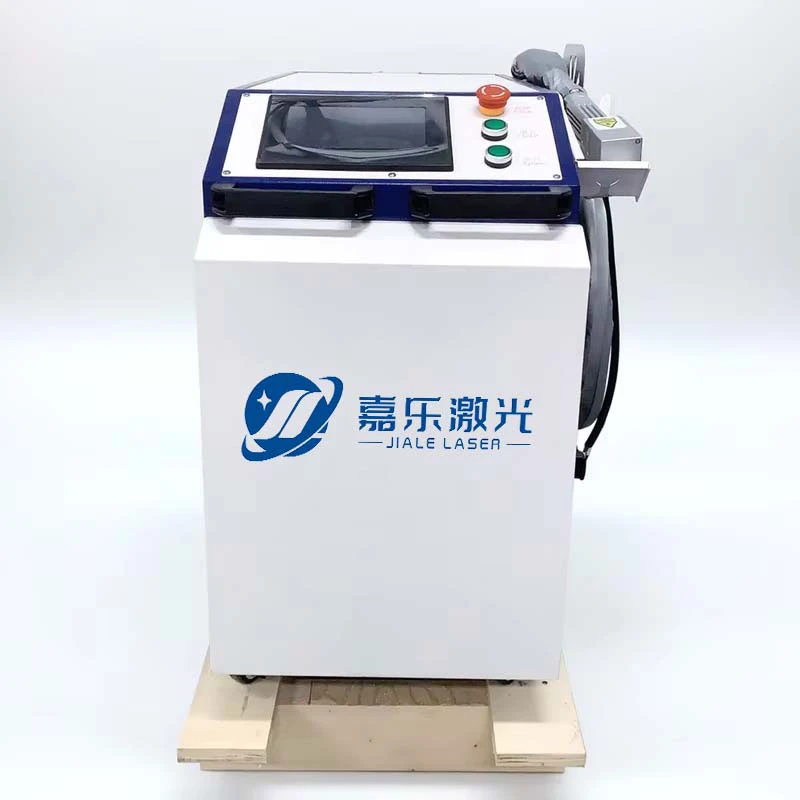
Non-contact Cleaning
Eliminating the need for mechanical friction or chemical immersion, this method avoids scratches, deformation, or corrosion of the substrate, making it particularly suitable for high-precision, high-value components (such as aero-engine blades and chip pins).
Environmentally Friendly and Pollution-Free
The entire process requires no chemical reagents and produces no wastewater, waste materials, or toxic gases, complying with RoHS, REACH, and other environmental standards, helping companies achieve carbon neutrality goals.
Precise and Controllable
By adjusting laser parameters (power, pulse width, frequency, and scanning speed), customized cleaning solutions can be developed for different materials and contaminants, with cleaning depth controllable to the micron level.
Highly Efficient and Energy-Saving
Cleaning speeds can be several to tens of times faster than traditional methods, while energy consumption is only one-third that of chemical cleaning, making it suitable for large-scale automated production lines.
Adaptable to Complex Structures
Combined with robots or scanning galvanometer systems, it can clean areas that are difficult to reach with traditional methods, such as deep holes, blind grooves, and curved surfaces, resulting in a more thorough cleaning.
Application areas of laser cleaning
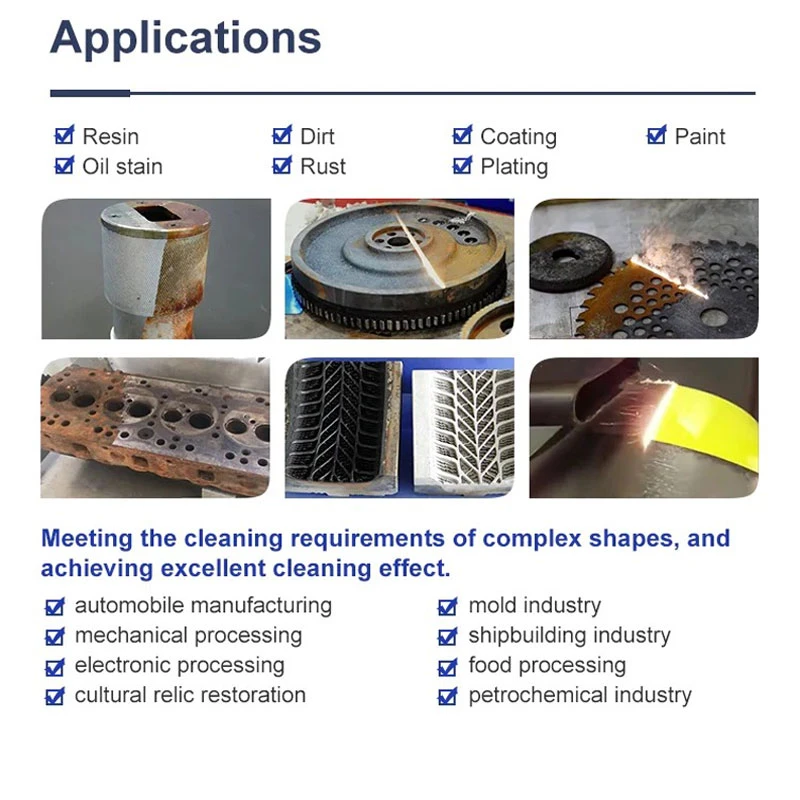
Industrial Manufacturing
Automotive Industry: Tire mold cleaning (removal of sulfide residue), engine block degreasing, weld joint cleaning.
Aerospace: Coating removal from titanium alloy components, turbine blade thermal barrier coating removal, composite material surface treatment.
Electronics & Electrical Appliances: Oxide removal from chip leads, circuit board pre-soldering cleaning, battery tab soldering surface treatment.
Mold Maintenance: Removal of adhesive residue and carbon deposits from injection molds and die-casting molds to extend mold life.
Cultural Heritage Conservation
Cleansing of soot, biofilm, or corrosion layers from stone carvings, murals, and metal artifacts to restore their original appearance without damage.
Medical Field
Cleansing of processing residues from orthopedic implants (such as hip joint prostheses) to ensure sterility and surface roughness meeting bone cell adhesion requirements.
Cleansing of biological contaminants from surgical instruments to prevent cross-infection.
New Energy Industry
Pre-welding cleaning of power battery tabs to improve weld quality and conductivity.
Removing impurities from photovoltaic silicon wafer surfaces to improve battery conversion efficiency.
Comparison of laser cleaning and traditional cleaning methods
| Comparison items | Laser cleaning | Chemical cleaning | Mechanical grinding |
|---|---|---|---|
| Environmental friendliness | No chemical pollution, zero wastewater discharge | Wastewater treatment required, posing a risk of heavy metal contamination | Dust is generated, requiring dust removal equipment. |
| Substrate damage | No mechanical stress, small heat-affected zone | May corrode substrate | Easily scratches the surface and alters its shape. |
| Cleaning precision | Micron-level controllability | Dependence on the homogeneity of chemical reagents | Depends on operator skills |
| Applicable scenarios | Complex structure, high-precision components | Large-area planar cleaning | Rough surface treatment |
| Cost | High initial equipment investment, low long-term operating costs | Chemical reagents are expensive, and waste liquid treatment is costly. | High labor costs and high consumption of consumables |
Conclusion
Laser cleaning technology has achieved a revolutionary breakthrough in cleaning methods through the interaction of light and matter. Its high efficiency, environmental friendliness, and precision are driving the manufacturing industry towards green and intelligent transformation. With the decrease in technology costs and the expansion of application scenarios, laser cleaning is expected to become the standard solution in the future industrial cleaning field, injecting new momentum into global industrial upgrading.